
MEETINGS
Meetings
Three Kinds of Secret Meetings
1. PERSONAL MEETINGS
In a previous section we began to discuss the methods members of an underground unit should use when communicating with one another. The most important requirement that must be solved is how to meet secretly and reliably.
Let us suppose that comrade A has the task of organising an underground unit with B and C. In the interests of secrecy they must, as far as possible, avoid visiting one another at home or at work. (Such links must be kept to a minimum or even totally avoided so that other people do not have the impression that they are closely connected.)
First of all they need to have a regular or main meeting – let's say every two weeks. For this meeting A lays down three conditions. These are: place, time and legend.
Place of Meeting
This must be easy to find, approach and leave. It must be a safe place to meet, allowing privacy and a feeling of security. It could be a friend's flat, office, picnic spot, beach, park, vehicle, quiet café, etc. The possibilities are endless.
It is essential that the meeting place be changed from time to time. Sometimes instead of indicating the meeting place, A might instruct B and C to meet him at different points on the route to the meeting such as outside a cinema, bus stop, etc. This can provide a greater degree of security. But it is best to begin with the most simple arrangements.
Time
Date and time of the meeting must be clearly memorised. Punctuality is essential. If anyone fails to arrive at the meeting place within the prearranged time, the meeting must be cancelled. As a rule the time for waiting must never exceed ten minutes. Under no circumstances must a comrade proceed to the meeting if he or she finds themselves under surveillance.
Legend
This is an invented but convincing explanation (cover story) as to why A, B and C are always together at the same place at the same time. The legend will depend on the type of people who are meeting.
Suppose A and B are black men and C is an older, white woman. Since it would look unusual and attract attention if they met at a park or picnic place, A has decided on an office which C has loaned from a reliable friend. They meet at 5.30pm when the office is empty.
C has told her friend that she requires the premises in order to interview some people for a job or some story to that effect. On the desk she will have interview notes and other documents to support her story and B and C will carry job applications or references.
If anyone interrupts the meeting or if they are questioned later, they will have a convincing explanation for their meeting.
Order of the Meeting
At the start of the meeting A checks on the well-being and security of each comrade, particularly whether everything was in order on their route to the meeting. Did they check for possible surveillance?
Next A will inform them of the legend for the meeting. Then, before business is discussed, A will pass around a piece of paper with the time and place of the next meeting written on it. Nothing is spoken in case the meeting is bugged.
This matter is settled in case they are interrupted and have to leave the meeting in a hurry. In such an event they already know the conditions for the next meeting and continuity of contact is assured.
Reserve Meeting
In arranging the regular meeting of the unit, A takes into account the possibility of one or more of them failing to get to that meeting. He therefore explains the conditions for a reserve meeting. These also include place, time and legend.
Whilst the time for a reserve meeting may be the same as a regular meeting (but obviously on a different day), the place must always differ.
A instructs them that if a regular meeting fails to take place they must automatically meet two days later at such-and-such a time and place.
The conditions for a reserve meeting might be kept constant, not changing as often as those of the regular meeting, because the need for such a meeting may not often arise. But A takes care to remind the comrades of these conditions at every regular meeting.
Having arranged conditions for both regular and reserve meetings, A feels confident that he has organised reliability and continuity of such contact. It is necessary for all to observe the rules of secrecy, and to be punctual, reliable, disciplined and vigilant about such meetings.
But what if comrade A needs to see B and C suddenly and urgently and cannot wait for the regular meeting?
2. EMERGENCY AND CHECK MEETINGS
The leader of an underground unit, comrade A, has arranged regular and reserve meetings with B and C. This allows for reliability and continuity of contact in the course of their secret work. This has been progressing well.
Comrade A decides to organise other forms of meetings with them because of the complexity of work.
Emergency Meeting
The comrades have found that they sometimes need to meet urgently between their regular meetings. An emergency meeting is for the rapid establishment of contact should the comrades need to see each other between the set meetings.
There are similar conditions as for a regular meeting such as: time, place and legend. The additional element is a signal for calling the meeting.
This signal might be used by either the unit leader A or the other cell members when they need to convey urgent information.
A confirmation signal is also necessary which indicates that the call signal has been seen or understood. This must never be placed at the same location as the call signal.
Signals
These are prearranged signs, phrases, words, marks or objects put in specified places such as on objects in the streets, on buildings, etc., or specified phrases in postcards, letters, on the telephone, etc.
Example of Emergency Meeting
Comrade A has directed that the venue for the unit's emergency meeting is a certain park bench beside a lake. The time is for 5.30pm on the same day that the call signal is used. As with regular meetings, he also indicates a reserve venue for the emergency meeting.
Comrade A arranges different call signals for B and C, which they can also use if they need to summon him.
Call and Answer Signal for B
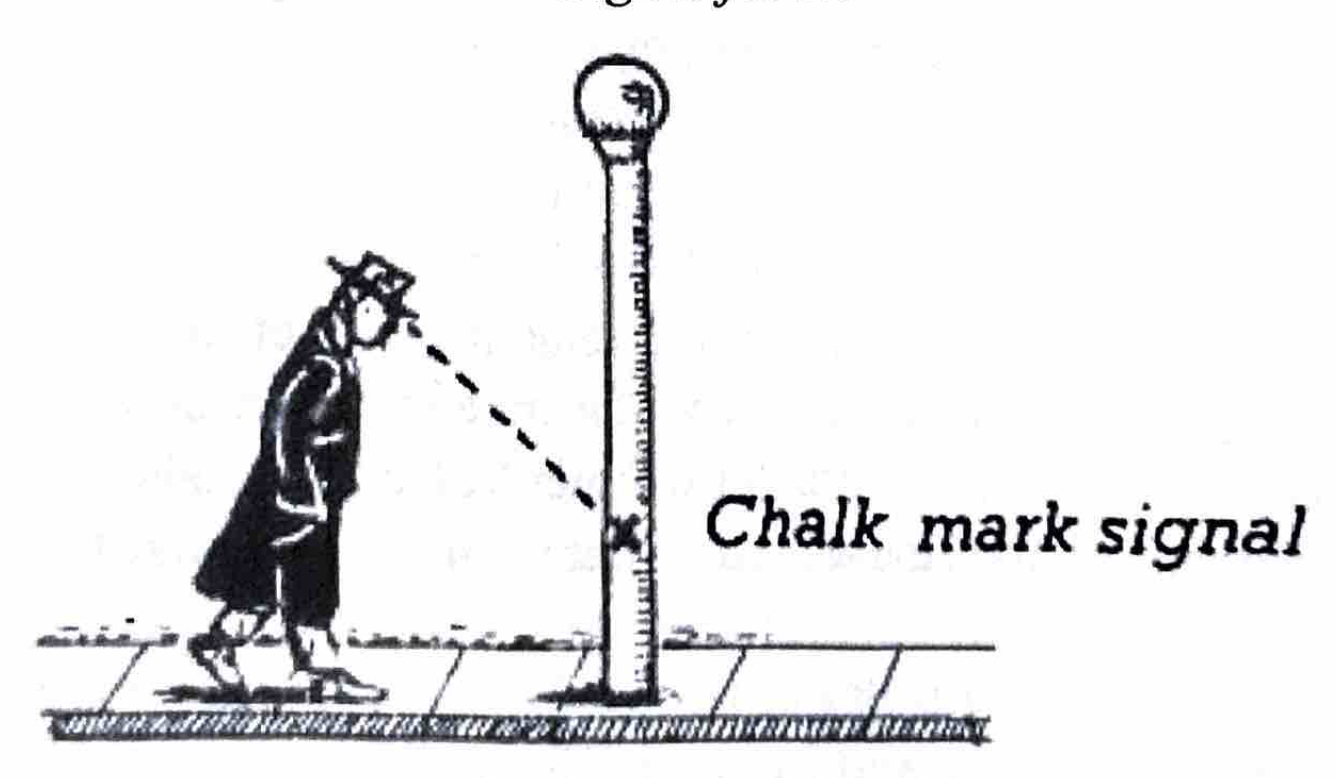
This signal could be a chalk mark placed by A on a certain lamp-post. Comrade A knows that B walks past the pole every morning at a certain time on his way to work. B must always be on the lookout for the chalk mark. This could simply be the letter ‘X’ in red chalk.
By 2pm that day B must have responded with the confirmation signal. This could be a piece of coloured string wound round a fence near a bus stop. It could equally be a piece of blue chalk crushed into the pavement by the steps of a building or some graffiti scrawled on a poster (in other words, anything clear, visible and innocent-looking).
The two comrades can now expect to meet each other at the park bench later that day.
Call and Answer Signal for C
C has a telephone at home. Before she leaves for work, comrade A phones her from a public call-box. He pretends to dial a wrong number.
“Good morning, is that Express Dairy?” he asks.
“Sorry, wrong number,” C replies and adds: “Not such a good morning, you got me out of the bath.”
This is C's innocent way of confirming that she has understood the signal. Obviously, such a signal cannot be repeated.
Check Meeting
This is a ‘meeting’ between the unit leader and a subordinate comrade to establish, only through visual contact, whether the comrade is all right.
Such a check-up becomes necessary when a comrade has been in some form of danger and where direct physical contact is unsafe to attempt, such as if the comrade has been questioned by the police or been under surveillance.
There are a number of conditions for such a meeting: date and time; place or route of movement; actions; legend; signals – indicating danger or well-being.
Example of Check Meeting
C has been questioned by the police. As a result, contact with her has been cut. After a few days, comrade A wants to check how she is and calls her through a signal to a check meeting.
At 4pm on the day following the call signal, C goes shopping. She wears a yellow scarf indicating that she was indeed questioned and that everything has appeared normal since.
She follows a route which takes her past the Post Office by 4.20pm. She does not know where A is, but he has taken up a position which conceals his presence and gives him a good view of C.
He is also able to observe whether C is being followed. On passing the Post Office, C stops to blow her nose. This is to reinforce her feeling that everything is now normal.
It is for A to decide whether to restore contact with C or to leave her on ‘ice’ for a while longer, subjecting her to further checks.
3. BLIND MEETING
The leader of an underground unit, comrade A, receives instructions from the leadership to meet comrade D. Comrade D is a new recruit, whom the leadership are assigning to A's unit.
A and D are strangers to one another. Conditions are therefore drawn up for a blind meeting – that is, a meeting between two underground workers who are unknown to one another.
Recognition Signs and Passwords
There are similar conditions as for regular and other forms of meeting, such as date, time, place, action of subordinate and legend. In addition, there is the necessity for recognition signs and passwords, which are to aid in identification.
The recognition signs enable the commander or contactor, in this case A, to identify the subordinate from a safe distance and at close quarters. Two recognition signs are therefore needed.
The passwords, including the reply, are specially prepared words and phrases which are exchanged and give the go-ahead for the contact to begin. These signs and phrases must look normal and not attract attention to outsiders.
At this point the reader should prepare an example for a blind meeting and compare it with the example we have given. Our example has been purposely printed upside down to encourage the reader to participate in this suggested exercise.
Do remember that all the examples given in our series are also read by the enemy, so do not blindly copy them. They are suggestions to assist activists with their own ideas.
Example of Blind Meeting
Place: Toyshop on Smith Street.
Date and Time: December 20th, 6pm.
Action: Comrade D to walk down the street in an easterly direction, stop at the toyshop, and gaze at the toy display for five minutes.
Legend: D is simply walking about town carrying out window shopping. When A makes contact they are to behave as though they are strangers who have just struck up a friendship.
Recognition signs: D carries an OK Bazaars shopping bag. The words ‘OK’ have been underlined with a black pen (for close-up recognition).
Passwords
A: Pardon me, but do you know whether this shop sells children's books?
B: I don't know. There are only toys in the window.
A: I prefer to give books for presents.
Note: The opening phrase will be used by A after he has observed D's movements and satisfied himself that the recognition signs are correct and that D has not been followed.
A completes the passwords with a closing phrase which satisfies D that A is the correct contact. The two can now walk off together or A might suggest a further meeting somewhere else.
Brush Meeting
This is a brief meeting where material is quickly and silently passed from one comrade to another.
Conditions for such a meeting, such as place, time and action, are carefully planned beforehand. No conversation takes place.
Money, reports or instructions are swiftly transferred. Split-second timing is necessary and contact must take place in a dead zone, i.e., in areas where passing the material cannot be seen.
For example, as D walks down the steps of a department store, A passes D and drops a small package into D's shopping bag.
’Accidental’ Meeting
This is, in fact, a deliberate contact made by the commander which comes as a surprise to the subordinate. In other words, it takes place without the subordinate's foreknowledge.
An ‘accidental’ meeting takes place where:
- There has been a breakdown in communication.
- The subordinate is not fully trusted and the commander wants to have an ‘unexpected’ talk with him or her.
The commander must have good knowledge of the subordinate’s movements and plan his or her actions before, during and after the meeting.